HRV and Sleep: What Your Heart Rate Variability Actually Tells You
Heart rate variability (HRV) reflects your autonomic nervous system balance and sleep recovery. Higher HRV typically indicates better recovery, while declining trends may signal overtraining or stress.
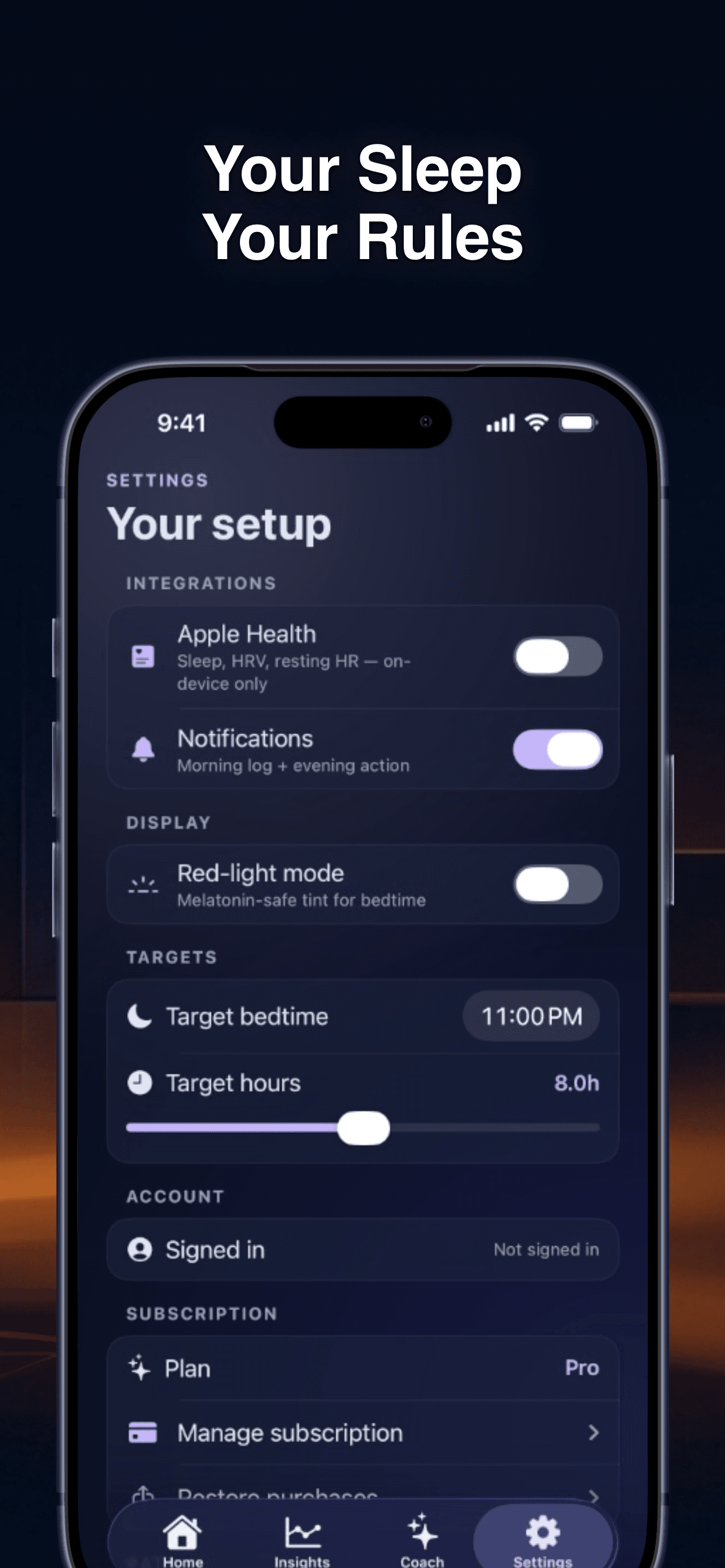
Photo by Sleep Arc.
Your Apple Watch measures something called heart rate variability (HRV) every night. Most people ignore this number or find it confusing. That's a mistake.
HRV reflects the balance of your autonomic nervous system—specifically how well your parasympathetic (rest and digest) system recovers during sleep. Higher HRV generally indicates better recovery and readiness, while consistently declining HRV may signal overtraining, illness, or chronic stress affecting your sleep quality.
I've been tracking my HRV for eighteen months. The patterns became clear after about six weeks: nights with alcohol dropped my next-morning HRV by 15-20 points. Late workouts did the same. But the most interesting discovery was how my HRV predicted my energy levels better than my subjective sleep rating.
What Is Heart Rate Variability?
HRV measures the tiny variations in time between each heartbeat. A healthy heart doesn't beat like a metronome—it speeds up slightly on inhale, slows on exhale. This variation reflects your vagus nerve activity and overall autonomic balance.
During deep sleep, your parasympathetic nervous system should dominate. This shows up as higher HRV. When you're stressed, overtrained, or fighting illness, your sympathetic (fight-or-flight) system stays active, reducing HRV even during sleep.
Your baseline HRV depends on age, fitness level, and genetics. A 25-year-old athlete might have an HRV of 60ms, while a 50-year-old's healthy range might be 25ms. The absolute number matters less than your personal trends.
How Sleep Affects Your HRV
Quality sleep directly impacts your HRV recovery. Here's what the research shows:
- Deep sleep stages: Your HRV typically peaks during slow-wave sleep when parasympathetic activity is highest
- REM sleep: HRV often drops during REM as your nervous system becomes more active
- Sleep debt: Chronic sleep restriction consistently lowers HRV over time
- Sleep timing: Going to bed significantly later than usual can reduce next-morning HRV
Poor sleep architecture—lots of wake-ups, insufficient deep sleep, or fragmented REM—prevents your autonomic nervous system from fully recovering. This shows up as lower HRV the next morning.
Reading Your HRV Trends
Daily HRV numbers bounce around. What matters is the 7-day rolling average and longer trends. Here's how to interpret your data:
Declining trend over 1-2 weeks: Often indicates accumulated stress, overtraining, or developing illness. Consider prioritizing sleep and reducing training intensity.
Sudden 20%+ drop: May signal acute stress, poor sleep, alcohol consumption, or early illness. Pay attention to other recovery metrics.
Gradual increase over months: Usually reflects improved fitness, better sleep habits, or reduced chronic stress.
Stable baseline with normal fluctuations: Indicates good recovery balance. Small day-to-day variations (±10-15%) are normal.
What Impacts HRV During Sleep
Several factors consistently affect HRV recovery during sleep:
Temperature: Sleeping hot reduces HRV. Your core body temperature naturally drops 1-2 degrees during sleep to facilitate recovery. Room temperatures above 70°F can interfere with this process.
Alcohol: Even moderate drinking (1-2 drinks) can reduce HRV by 10-30% that night. Alcohol disrupts sleep architecture and keeps your sympathetic nervous system more active.
Late meals: Eating within 3 hours of bedtime forces your digestive system to work during sleep, reducing parasympathetic dominance and HRV.
Exercise timing: Intense workouts within 4 hours of bedtime can keep your heart rate and sympathetic activity elevated, lowering HRV.
Stress and anxiety: Mental stress activates your sympathetic nervous system, directly reducing HRV even if you fall asleep quickly.
How Sleep Arc Uses Your HRV Data
Sleep Arc integrates with Apple Health to pull your HRV data alongside sleep metrics. The AI coach looks at patterns between your HRV trends and sleep quality ratings to identify what's actually impacting your recovery.
Instead of just showing you numbers, Sleep Arc connects HRV drops to specific behaviors. If your HRV consistently drops after late workouts, the coach might suggest moving exercise earlier. If alcohol correlation appears, you'll get targeted advice about timing or quantity.
The key insight: HRV works best as one data point among several, not as a standalone metric. Sleep Arc combines HRV with your subjective sleep quality, bedtime consistency, and other Apple Health metrics to give you one concrete action each night.
Optimizing HRV Through Better Sleep
Focus on these evidence-based strategies to improve your HRV recovery:
Consistent sleep schedule: Going to bed and waking at similar times helps regulate your circadian rhythm and autonomic balance.
Cool sleeping environment: Keep your bedroom between 65-68°F to support natural temperature drops during sleep.
Limit evening alcohol: If you drink, finish at least 3 hours before bedtime to minimize HRV impact.
Manage evening stress: Use relaxation techniques, dim lights, or gentle stretching to activate your parasympathetic system before sleep.
Time your workouts: Finish intense exercise at least 4 hours before bedtime when possible.
The goal isn't to maximize HRV every single night. It's to maintain a stable baseline with good recovery trends over weeks and months.
Your HRV data becomes most valuable when you connect it to your actual sleep experience and daily habits. That's where an AI coach that understands both the numbers and your patterns makes the biggest difference.
Frequently asked questions
- What's a good HRV range for sleep recovery?
- HRV ranges vary widely by age and fitness level. A healthy 25-year-old might see 40-80ms, while a 50-year-old's range might be 15-40ms. Focus on your personal baseline and 7-day trends rather than comparing to others.
- How quickly does poor sleep affect HRV?
- HRV typically drops within one night of poor sleep quality. A single bad night might reduce your HRV by 10-20%, while chronic sleep debt can lower your baseline over weeks.
- Can I improve my HRV just by sleeping better?
- Yes, consistent quality sleep is one of the most effective ways to improve HRV. Better sleep timing, cooler temperatures, and reduced evening alcohol can increase HRV by 15-25% over 2-4 weeks.
- Should I change my sleep schedule based on daily HRV readings?
- No, daily HRV fluctuates normally. Look at 7-day trends instead. If your rolling average drops 20%+ for several days, prioritize extra sleep and stress reduction, but don't make nightly changes based on single readings.