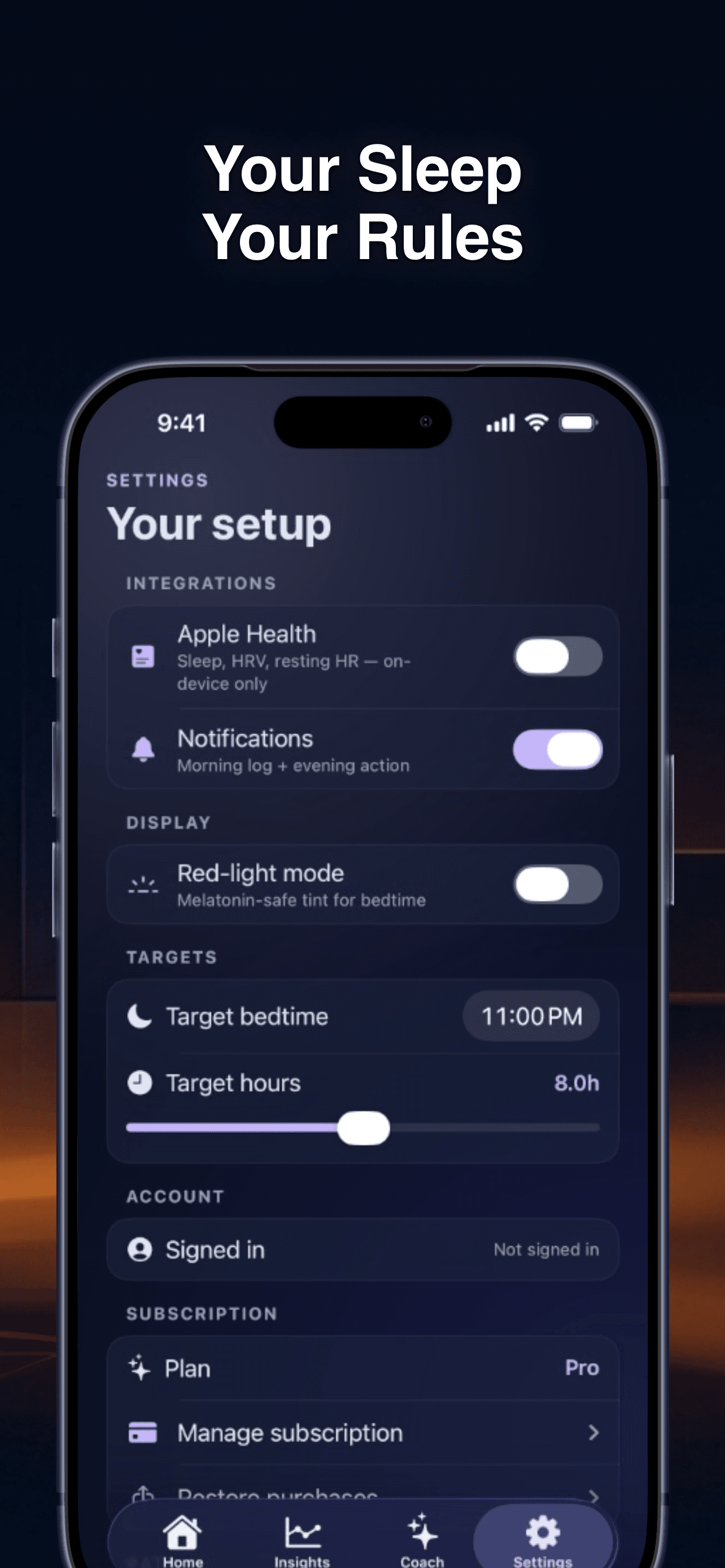
The Ten-Second Sleep Log That Actually Changes Behavior
Detailed sleep journals fail because nobody fills them out. Here's the minimum-viable nightly log that surfaces the patterns that matter — and what to leave out.
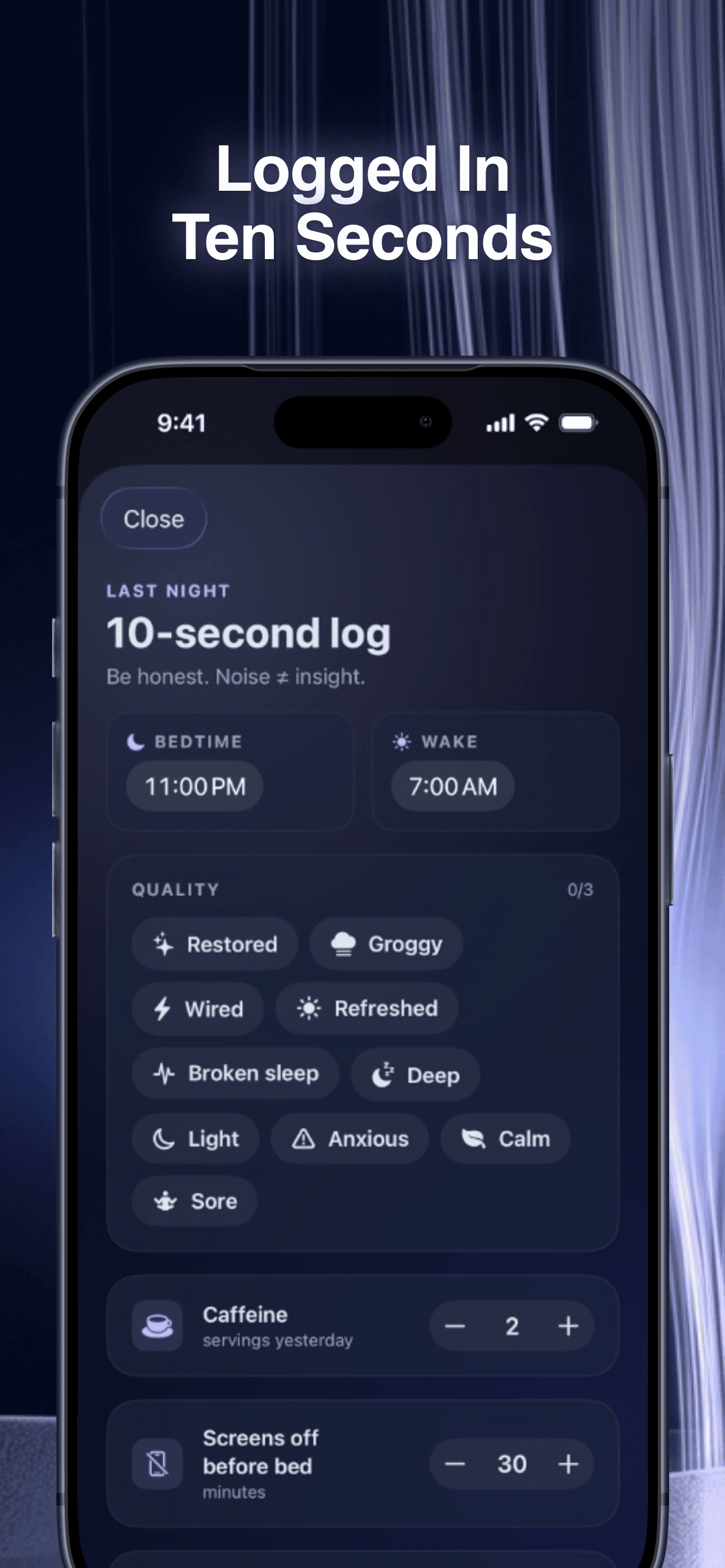
There's a paradox at the heart of sleep tracking: the more detailed the journal, the less useful it is. Not because the data is wrong, but because nobody fills it out past day four.
I've watched hundreds of people try to track sleep with a 20-field journal. Almost everyone abandons it within two weeks. The ones who stick with tracking long enough to see real patterns are using something closer to a six-field log they can complete in ten seconds.
Here's what that log actually looks like, and why each field earns its place.
The minimum-viable log
Four numbers and up to four tags. That's it.
Bedtime. The time you actually tried to sleep, not the time you got into bed to scroll.
Wake time. The time your feet hit the floor, not the time your alarm went off.
Subjective quality (1–5). How rested do you feel right now? This is the single most predictive input in most studies — it correlates with HRV and next-day performance better than total sleep time does.
Night disturbances (yes/no). Did you wake up for more than a few minutes? That's it. You don't need to time it.
And then up to four quality tags, picked from a short list:
- Caffeine after noon
- Alcohol
- Late heavy meal
- Screens past wind-down
- Hard workout after 7 p.m.
- Stressful day
- Unusual timing (travel, late event)
That's the whole thing. Ten seconds if you're honest. Twenty if you're hedging.
Why this works when detailed journals don't
Three reasons.
One: adherence beats resolution. A six-field log filled out for 90 nights beats a 20-field log filled out for 9. Patterns need statistical mass, and mass only comes from consistency.
Two: the things you'd add to a longer journal don't actually carry much signal at the individual level. Deep-sleep minutes from a wearable, for instance, are fuzzy enough at consumer-grade accuracy that they rarely move the needle on recommendations. Your subjective 1–5 rating does a lot of the same work and takes one tap.
Three: tags capture the cause side of the cause-effect relationship. Raw sensor data only shows the effect. If your score is 68 tonight, knowing your HRV was 42 doesn't help — knowing you had three drinks and screens until 12:15 a.m. does.
The honesty problem
The most common failure mode isn't forgetting to log. It's lying — usually to yourself.
You had coffee at 2 p.m., but you don't tag it because "it's not that late." You had two glasses of wine with dinner, but you don't tag it because "that's just normal." You went to bed at 11:45, but you log 11:15 because that's when you got in bed.
This wrecks the log. The whole point is to find the lever that moves your score, and you can't find it if you've scrubbed the evidence.
A useful rule: if you're debating whether to tag something, tag it. The cost of a false positive is zero. The cost of a false negative is a month of confused pattern-matching.
What to leave out
A surprising amount of stuff you see in sleep templates doesn't earn its field:
- Room temperature. Unless it varies wildly night to night, it's a constant — and constants don't explain variance.
- Dream recall. Fun, but not actionable.
- Mood when waking. Already captured in your 1–5.
- Detailed food log. Too noisy to be useful at the nightly level. "Late heavy meal" as a tag is enough.
If a field is going to be the same value on 80% of your nights, cut it. It's noise masquerading as data.
The seven-day compare
Once you have two weeks of logs, run this comparison every Sunday. It takes two minutes:
- Look at your five best nights. Which tags are missing?
- Look at your five worst. Which tags keep showing up?
- Pick the tag with the biggest delta. That's your target for the next week.
If caffeine-after-noon is on four of your five worst nights and zero of your five best, your assignment for next week is "no caffeine after 12." Don't try to fix everything. One lever per week.
This is exactly what Sleep Arc's coach runs automatically each morning — but you can do it with a notebook. The method is the value, not the tooling.
The coach is just a faster version of this
The reason we built a one-action-per-night coach is that most people know the method above works, and still don't run it, because it requires twenty minutes of pattern-matching they don't have on a Tuesday morning.
So we compressed it. You log for ten seconds. An AI reads your last seven nights and writes the one thing to change for tonight. That's the entire loop.
If you want to build the habit yourself with pen and paper, the six-field log above is the whole playbook. If you want a coach to do the pattern-matching for you, that's what Sleep Arc is.
Frequently asked questions
- Do I need a wearable to log sleep?
- No. The highest-value inputs are subjective — bedtime, wake time, how rested you feel, and a handful of quality tags. A wearable adds HRV and resting HR, which are useful but secondary.
- How long before I see patterns?
- Fourteen nights is the floor. You need enough good and bad nights to compare. Thirty nights is when habits and levers become obvious.